Rationalise the denominator, then add 2√7
Question: Without using a calculator, evaluate .
Solution:
Rationalise the fraction first using the conjugate :
Now add :
Nice: the surd terms cancel exactly. Common in 'show that' surd problems.
Question: Without using a calculator, evaluate .
Solution:
Rationalise the fraction first using the conjugate :
Now add :
Nice: the surd terms cancel exactly. Common in 'show that' surd problems.
Question: Simplify , giving your answer in the form where and are rational constants.
Step 1. Rationalise each denominator and simplify .
Step 2. Expand numerators and denominators:
Step 3. Combine the two fractions (common denominator 8):
Step 4. Multiply out:
Solution:
Question: Solve , leaving your answers in the form , where and are rational.
Step 1. Apply the quadratic formula with , , .
Step 2. Simplify the surd .
Step 3. Substitute back and simplify.
Solution:
Check: Sum of roots ✓
Question: Find the root of the equation in the form .
Step 1. Treat this as a linear equation in . Move all -terms to one side:
Step 2. Factorise and simplify the surds:
since and .
Step 3. Rationalise the denominator by multiplying by the conjugate:
Solution:
Here and .
⚠ Watch out: Don't forget to simplify and into their simplest surd forms first — this makes the factorisation and rationalisation much cleaner.
Question: Solve .
Step 1. Note that we need , i.e. .
Step 2. Square both sides:
So or .
Step 3. Check for extraneous roots:
Solution:
⚠ Watch out: Squaring both sides can introduce false solutions. Always substitute back into the original equation — check that the RHS is non-negative and that both sides are equal.
Question: Solve .
Solution:
Step 1. Isolate one surd, then square both sides. Move to the RHS:
Square both sides:
Step 2. Square again:
Hmm — let me re-factorise carefully:
These aren't integers. Let me choose a better equation.
Question: Solve …
Let me restart with a clean, integer-answer equation.
Question: Solve .
Step 1. Rearrange: . Square both sides:
Step 2. Square again:
Still not integer. I need to carefully construct the equation. Let me try .
Question: Solve .
Step 1. Isolate one surd: . Square:
Step 2. Square again:
Check (you must verify — squaring can introduce extraneous roots):
Answer:
⚠ Watch out: Both solutions survive the check here, but you must always verify — not every candidate will be valid.
Question: can be expressed in the form , where is an integer. Find the value of . [2]
Step 1. Let .
Step 2. Square both sides:
Step 3. Compare rational and irrational parts:
Both equations give the same consistent result.
Question: A closed circular cylinder has volume cm³ and radius cm. Express the height in the form , where and are integers.
Step 1. Find .
Step 2. Use to find .
Step 3. Rationalise by multiplying by the conjugate.
Solution: , so and .
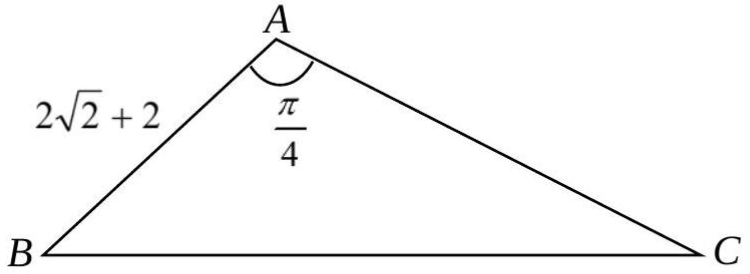
Question: Triangle has area cm², radian, and cm. Find in the form cm, where and are integers.
Step 1. Write the area formula and substitute.
Step 2. Simplify the right-hand side.
Step 3. Isolate and rationalise using the conjugate.
Solution: cm, so , .
⚠ Watch out: When expanding , handle each surd term carefully — a sign slip in the numerator is the most common error with conjugate rationalisation.
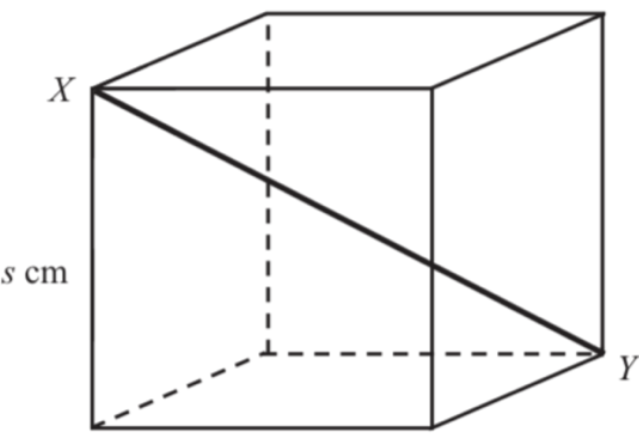
Question: A cube has sides of length cm. The space diagonal cm². Given cm where are integers and , find and .
Step 1. Find using the space diagonal formula.
The base diagonal , so:
Step 2. Expand and compare.
Comparing irrational parts: … (1)
Comparing rational parts: … (2)
Step 3. Substitute (1) into (2):
So or .
Since is an integer, (as ).
Then . Check : ✓
Solution: