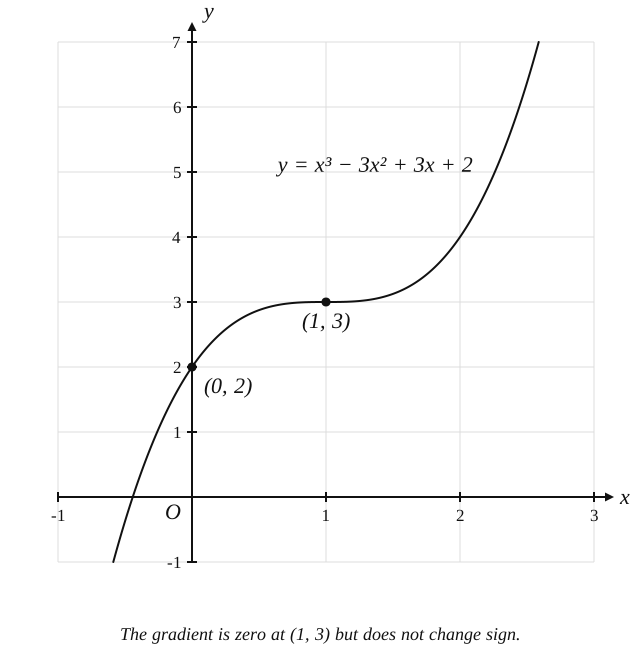
Question: The curve y=x3−3x2+3x+2 has exactly one stationary point. Find its coordinates and determine its nature.
Step 1. Differentiate and set dxdy=0:
dxdy=3x2−6x+3=3(x−1)2=0⟹x=1
Then y(1)=1−3+3+2=3, so the stationary point is (1,3).
Step 2. Try the second derivative:
dx2d2y=6x−6=0 at x=1
The test is inconclusive — it tells us nothing here, so fall back to the sign of dxdy.
Step 3. First-derivative sign test either side of x=1:
x=0.9:dxdy=3(−0.1)2=+0.03x=1:0x=1.1:dxdy=3(0.1)2=+0.03
The gradient goes +,0,+ — positive on both sides: the curve flattens momentarily and keeps rising, so this is neither a maximum nor a minimum.
(1,3) is a stationary point of inflexion.
⚠ Watch out: dx2d2y=0 does not prove an inflexion — y=x4 has y′′=0 at x=0, yet that point is a minimum. Whenever the second derivative comes out zero, you must do the first-derivative sign test; quoting "y′′=0, hence inflexion" loses the mark.