Why this works: The perpendicular bisector is the set of points equidistant from A and B. It always passes through the midpoint with gradient ⊥ to the original segment.
Angle of inclination from the gradient
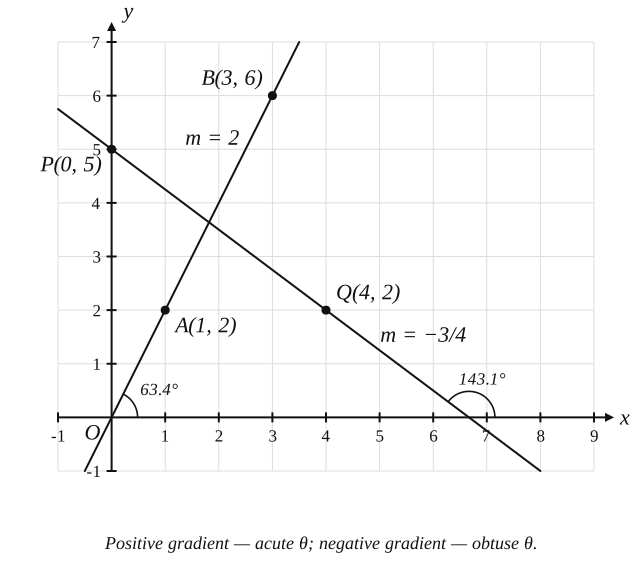
Question: Find the angle of inclination (the angle made with the positive x-axis) of
(a) the line through A(1,2) and B(3,6); (b) the line through P(0,5) and Q(4,2).
Give each answer correct to 1 decimal place.
Step 1. (a) Find the gradient:
m=3−16−2=2
Step 2. The angle of inclination θ is measured anticlockwise from the positive x-axis to the line, and m=tanθ. Since m>0, the angle is acute:
θ=tan−12=63.4∘(1 d.p.)
Step 3. (b) Find the gradient:
m=4−02−5=−43
Step 4. Since m<0, the angle is obtuse — take 180∘ minus the basic angle:
θ=180∘−tan−143=180∘−36.9∘=143.1∘(1 d.p.)
⚠ Watch out: Keying tan−1(−0.75) into a calculator returns −36.9∘, which is not an inclination. The angle with the positive x-axis always satisfies 0∘≤θ<180∘: for a negative gradient use θ=180∘−tan−1∣m∣.
Line parallel through a given point
Question: Find the equation of the line parallel to 2x−3y+5=0 passing through (4,−1).
Step 1. Rearrange the given line to y=32x+35. Gradient m=32.
Step 2. Parallel lines share the same gradient. So the new line has gradient 32.
Step 3. Point-slope through (4,−1):
y−(−1)=32(x−4)⇒y+1=32x−38y=32x−311
Answer:y=32x−311 (or 2x−3y=11).
Tip: Convert the given line into y=mx+c form FIRST to read off m cleanly. Then build the new line by changing only the c.
Foot of perpendicular from a point to a line
Question: Find the foot of the perpendicular from P(7,2) to the line y=2x−1.
Step 1. Gradient of given line: m1=2. Perpendicular gradient: m2=−21.
Step 2. Perpendicular through P(7,2):
y−2=−21(x−7)⇒y=−21x+211
Step 3. Solve simultaneously with y=2x−1:
2x−125xx=−21x+211=213=513,y=2(513)−1=521
Answer: Foot F=(513,521).
Tip: Foot of perpendicular = intersection of (the given line) and (the perpendicular through the external point). Two-step plan, always.
Area of a triangle using the shoelace formula
Question: Find the area of triangle with vertices A(1,2), B(5,1), C(4,6).
Alternative method: Show mPQ=mQR:
mPQ=2−(−1)−2−4=−2mQR=5−2−8−(−2)=−2 ✓
Both methods work — pick whichever is faster.
Area of a quadrilateral built from line intersections
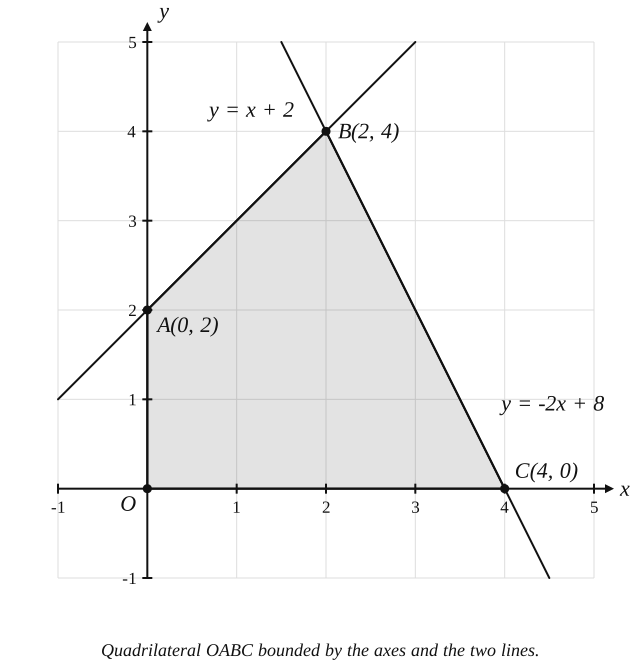
Question: The line y=x+2 cuts the y-axis at A and meets the line y=−2x+8 at B. The line y=−2x+8 cuts the x-axis at C. With O the origin, find the area of quadrilateral OABC.
Step 1. Find each vertex by solving the right pair of equations.
A (on the y-axis): put x=0 into y=x+2, so A(0,2).
C (on the x-axis): put y=0 into y=−2x+8, so x=4 and C(4,0).
Step 2.B is where the lines meet — equate them:
x+2=−2x+8⟹3x=6⟹x=2,y=4
So B(2,4).
Step 3. Shoelace with the vertices in order round the shape, O→A→B→C, closing back at O:
⚠ Watch out: The shoelace only works when the vertices are listed in order around the quadrilateral (and the list closes back at the start). Writing O,A,C,B traces a crossed shape and gives a wrong "area" with no warning — sketch first, then read the order off the sketch.
Point dividing a segment in a given ratio
Question: Find the point P that divides the segment from A(2,3) to B(8,9) internally in the ratio 1:2.
Step 1. Section formula for INTERNAL division in ratio m:n:
P=(m+nmxB+nxA,m+nmyB+nyA)
Step 2. With m=1, n=2, A(2,3), B(8,9):
P=(31(8)+2(2),31(9)+2(3))=(312,315)=(4,5)
Answer:P=(4,5).
Sanity check:P is closer to A than B (ratio 1:2 means AP:PB=1:2, so P is one-third of the way from A). The midpoint of A and B would be (5,6) — (4,5) is correctly closer to A. ✓
Tip: "Ratio m:n" means AP:PB=m:n. The formula puts m next to B's coordinates and n next to A's — easy to remember by "cross-multiply."
Locus: equidistant from two points
Question: Find the equation of the locus of a point P(x,y) that is equidistant from A(1,3) and B(5,−1).
Step 1. Equidistant means ∣PA∣=∣PB∣. Squaring (both sides non-negative):