Question: Rewrite x2+y2−4x+6y−12=0 in standard form and state the centre and radius.
Step 1. Group x-terms and y-terms; move the constant to RHS:
(x2−4x)+(y2+6y)=12
Step 2. Complete the square in each bracket.
For x: add (2−4)2=4.
For y: add (26)2=9.
Balance the equation by adding both to the RHS too:
(x2−4x+4)+(y2+6y+9)=12+4+9(x−2)2+(y+3)2=25
Step 3. Compare with (x−a)2+(y−b)2=r2:
Centre=(2,−3), radius=5.
⚠ Watch out:(y+3)2=(y−(−3))2, so the y-coordinate of the centre is −3, not +3. Track the sign.
swipe up ↑
🤖Ask
Circles
17 worked examples
Complete the square to find centre and radius
Question: Rewrite x2+y2−4x+6y−12=0 in standard form and state the centre and radius.
Step 1. Group x-terms and y-terms; move the constant to RHS:
(x2−4x)+(y2+6y)=12
Step 2. Complete the square in each bracket.
For x: add (2−4)2=4.
For y: add (26)2=9.
Balance the equation by adding both to the RHS too:
(x2−4x+4)+(y2+6y+9)=12+4+9(x−2)2+(y+3)2=25
Step 3. Compare with (x−a)2+(y−b)2=r2:
Centre=(2,−3), radius=5.
⚠ Watch out:(y+3)2=(y−(−3))2, so the y-coordinate of the centre is −3, not +3. Track the sign.
Build a circle from centre + radius, expand to general form
Question: Find the equation of the circle with centre (−1,4) and radius 13, in general form x2+y2+2gx+2fy+c=0.
Step 1. Start in standard form:
(x−(−1))2+(y−4)2=13⇒(x+1)2+(y−4)2=13
Step 2. Expand:
x2+2x+1+y2−8y+16x2+y2+2x−8y+4=13=0
Answer:x2+y2+2x−8y+4=0 (so g=1, f=−4, c=4).
Tip: General-form coefficients give centre (−g,−f) and radius g2+f2−c. Quick cross-check: g2+f2−c=1+16−4=13 ✓.
Circle touching both axes — find centre and radius
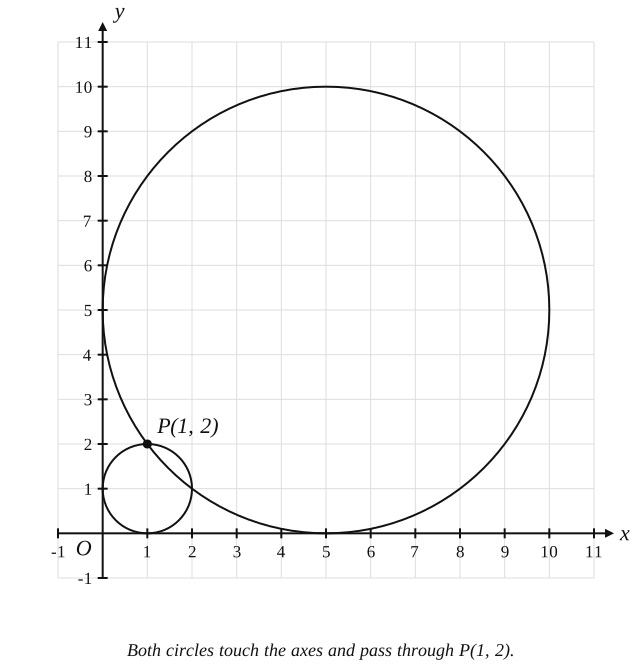
Question: A circle lies entirely in the first quadrant and touches both the x-axis and the y-axis. Given that it passes through the point (1,2), find the equation of each possible circle.
Step 1. Touching an axis means the distance from the centre to that axis equals the radius. Touching both axes (first quadrant) forces the centre to be (r,r) with r>0:
(x−r)2+(y−r)2=r2
Step 2. The circle passes through (1,2) — substitute:
(1−r)2+(2−r)2=r21−2r+r2+4−4r+r2=r2r2−6r+5=0
Step 3. Factorise and solve:
(r−1)(r−5)=0⟹r=1 or r=5
Both roots are positive, so both give a valid circle.
Step 4. State both equations:
r=1: centre (1,1), (x−1)2+(y−1)2=1
r=5: centre (5,5), (x−5)2+(y−5)2=25
Check the second: (1−5)2+(2−5)2=16+9=25=r2 ✓
⚠ Watch out: Do not discard r=5 because it "looks too big" — reject a root only for a real reason (e.g. r≤0). Here a small circle and a large circle both touch the axes and pass through (1,2).
Circle through three points (general form)
Question: Find the equation of the circle passing through A(0,0), B(8,0), C(4,4).
Step 1. Assume general form x2+y2+2gx+2fy+c=0.
Step 2. Substitute each point:
A(0,0): 0+0+0+0+c=0⇒c=0
B(8,0): 64+16g+c=0⇒16g=−64⇒g=−4
C(4,4): 16+16+8g+8f+c=0⇒32−32+8f=0⇒f=0
Step 3. Equation: x2+y2−8x=0.
Step 4. Convert: (x−4)2+y2=16. Centre (4,0), radius 4.
Tip: Always sub A first if it's (0,0) — gives c immediately.
Circle from two diameter endpoints
Question: Find the equation of the circle with diameter endpoints P(2,1) and Q(8,9).
Step 1. The centre is the midpoint of PQ:
C=(22+8,21+9)=(5,5)
Step 2. The radius is half the diameter ∣PQ∣:
∣PQ∣=(8−2)2+(9−1)2=36+64=10r=210=5
Step 3. Standard form:
(x−5)2+(y−5)2=25
Tip: "Diameter endpoints" is the simplest three-points case — only two points given, and the geometry handles the rest.
Find k so that a line is tangent (discriminant = 0)
Question: Find k such that the line y=2x+k is tangent to the circle x2+y2−4x+6y+4=0.
Centre (0,0). Distance from (0,0) to line 3x+4y−25=0:
d=9+16∣3(0)+4(0)−25∣=525=5
Radius =25=5. Distance = radius ⇒ tangent. ✓
Tip: Method 2 (distance from centre) is often quicker if both the centre and the line equation ax+by+c=0 are easy to read.
Tangent at a given point on the circle
Question: Find the equation of the tangent to (x−1)2+(y−2)2=25 at the point T(4,6).
Step 1. The tangent is perpendicular to the radius at the point of tangency.
Gradient of radius CT:
mCT=4−16−2=34
Step 2. Tangent gradient (negative reciprocal):
mtan=−43
Step 3. Equation of tangent through T(4,6):
y−6=−43(x−4)⇒y=−43x+9
Answer:y=−43x+9 (or 3x+4y=36).
Why this works: Radius ⊥ tangent at the point of tangency. So once you know the gradient of the radius, the perpendicular gives the tangent gradient in one step.
Tangent at the endpoint of a given diameter
Question: A circle has diameter endpoints A(0,0) and B(6,8). Find the equation of the tangent at A.
Step 1. The tangent at A is perpendicular to the radius (or equivalently the diameter) at A.
Gradient of AB:
mAB=6−08−0=34
Step 2. Perpendicular gradient: mtan=−43.
Step 3. Tangent through A(0,0):
y−0=−43(x−0)⇒y=−43x
Answer:y=−43x (or 3x+4y=0).
Tip: "Tangent at an endpoint of a diameter" never needs the centre — just the gradient of the diameter, then ⊥.
Chord length using the perpendicular distance from the centre
Question: A line y=x+1 cuts the circle x2+y2=25. Find the length of the chord.
Step 1. Distance from centre (0,0) to line x−y+1=0:
d=12+(−1)2∣0−0+1∣=21
Step 2. Half-chord length by Pythagoras (in the right triangle formed by radius, perpendicular distance, and half-chord):
Why this is faster: Solving for intersection points then computing distance works, but the perpendicular-distance method avoids the messy quadratic — direct Pythagoras.
Find intersection points of line and circle
Question: Find the points where y=x−1 meets the circle x2+y2=13.
Step 1. Substitute the line into the circle:
x2+(x−1)2=13
Step 2. Expand and solve:
x2+x2−2x+12x2−2x−12x2−x−6(x−3)(x+2)=13=0=0=0
So x=3 or x=−2.
Step 3. Get the y-coordinates from y=x−1:
x=3⇒y=2
x=−2⇒y=−3
Answer: Intersection points are (3,2) and (−2,−3).
Tip: Always sub the line into the circle (not vice versa). The line is linear, so the substitution yields one quadratic in x — clean.
Check if two circles touch on the outside
Question: Show that the circles x2+y2=4 and (x−5)2+y2=9 are externally tangent.
Step 1. Identify centres and radii:
C1=(0,0), r1=2
C2=(5,0), r2=3
Step 2. Distance between centres:
d=(5−0)2+(0−0)2=5
Step 3. Compare with sum / difference of radii:
Sum: r1+r2=2+3=5 ✓
Difference: ∣r1−r2∣=1
Since d=r1+r2, the circles are externally tangent.
Three configurations to remember:
d>r1+r2: circles don't meet (separate)
d=r1+r2: externally tangent
∣r1−r2∣<d<r1+r2: circles intersect at 2 points
d=∣r1−r2∣: internally tangent
d<∣r1−r2∣: one circle inside the other (no contact)
Find common chord of two intersecting circles
Question: Find the equation of the common chord of the circles
x2+y2−4x−2y−4=0(C1)x2+y2−8x−6y+16=0(C2)
Step 1. Subtract C2 from C1 (the x2+y2 terms cancel):
Why this works: A point on both circles satisfies both equations. Subtracting eliminates the quadratic terms, leaving a linear equation — that's the line through both intersection points (the common chord).
Tip: Use this trick to find the common chord WITHOUT having to compute the intersection points themselves.
Angle in a semicircle is 90°
Question:A(0,0) and B(10,0) are endpoints of a diameter of a circle. Show that C(8,4) lies on the circle, and verify ∠ACB=90°.
Step 1. Centre of circle = midpoint of AB:
M=(20+10,20+0)=(5,0)
Radius =21∣AB∣=5.
Step 2. Check C(8,4) on circle:
∣MC∣=(8−5)2+(4−0)2=9+16=5
✓
Step 3. Verify ∠ACB=90° via CA⋅CB=0:
CA=(0−8,0−4)=(−8,−4)CB=(10−8,0−4)=(2,−4)CA⋅CB=(−8)(2)+(−4)(−4)=−16+16=0 ✓
So ∠ACB=90° — confirming the angle-in-semicircle theorem.
Tip: Two equivalent tests for "right angle at C":
Distance test: ∣MC∣=r (C lies on the circle, so the theorem applies)
Vector test: CA⋅CB=0
Perpendicular from centre bisects a chord
Question: A chord of the circle x2+y2=25 has midpoint M(3,1). Find the equation of the chord.
Step 1. Theorem: the line from the centre to the midpoint of a chord is perpendicular to the chord.
Step 2. Gradient of line from centre (0,0) to M(3,1):
mOM=3−01−0=31
Step 3. Chord's gradient (perpendicular):
mchord=−3
Step 4. Equation of chord through M(3,1):
y−1=−3(x−3)⇒y=−3x+10
Answer: Chord: y=−3x+10 (or 3x+y=10).
Why this works: The radius drawn to the midpoint of any chord is perpendicular to that chord — a classical Euclidean result. Quick consequence: if you know the midpoint, you know everything about the chord's direction.
Classify a point inside / on / outside
Question: Determine whether each point lies inside, on, or outside the circle (x−2)2+(y+1)2=25:
(a)P(5,3)(b)Q(7,2)(c)R(0,6)
Method: Compute (x−2)2+(y+1)2 and compare with r2=25.
<25: inside
=25: on
>25: outside
Step 1.P(5,3): (5−2)2+(3+1)2=9+16=25 ✓ on the circle.
Tip: This is just the distance test in disguise. (x−a)2+(y−b)2 is the distance from (x,y) to the centre — compare with the radius. Squaring both sides skips the square root.
Find values of k so that a point is inside the circle
Question: Find the values of k for which the point (k,2) lies inside the circle x2+y2−4x−2y−11=0.
Step 1. Convert to standard form by completing the square:
(x−2)2+(y−1)2=16
Centre (2,1), radius 4.
Step 2. "Inside" means (k−2)2+(2−1)2<16:
(k−2)2+1<16(k−2)2<15∣k−2∣<152−15<k<2+15
Answer:2−15<k<2+15.
⚠ Watch out: Strict inequalities (<, not ≤) — "inside" doesn't include the boundary. Use ≤ if the question says "inside or on."